Thursday, September 15, 2005

How To Make Your Hair Look Like Dahvie Van

gravitational lens


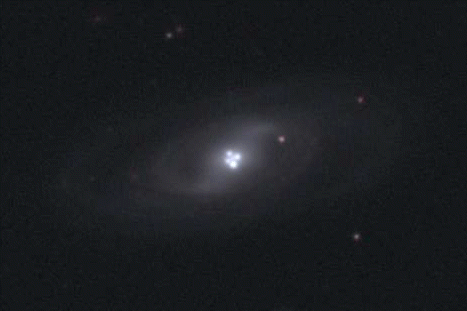
July 22, 2003 - An exceptional cosmic mirage: this is the definition used by astronomers at ESO, European Southern Observatory, commenting on the shooting of the Ring of Einstein discovered in the constellation Crater, using the 3.6-m telescope at La Silla (Chile).
The light from a distant quasar was in fact distorted and amplified by a galaxy interposed the line of sight, resulting in at least four images of "ghost" of the quasar itself, and a clear bright arc. The lens galaxy is visible as a bright central spot and diffused.
The effect, predicted by theory of general relativity (1916), is known as "Einstein ring", in honor of the great German physicist. The lens is designed
with the initials RXS J1131-1231: a galaxy far, about 3.5 billion light years from Earth, whose spectrum shows a red shift (redshift) of 0.3. Much farther away, according to the interpretation of cosmological redshift, the quasar would be: 6.3 billion years, corresponding to redshift 0.66.
Einstein ring is closer to Earth so far discovered.

Thursday, August 4, 2005

Labled Parts Of A Engine

Stroll through the Apennines

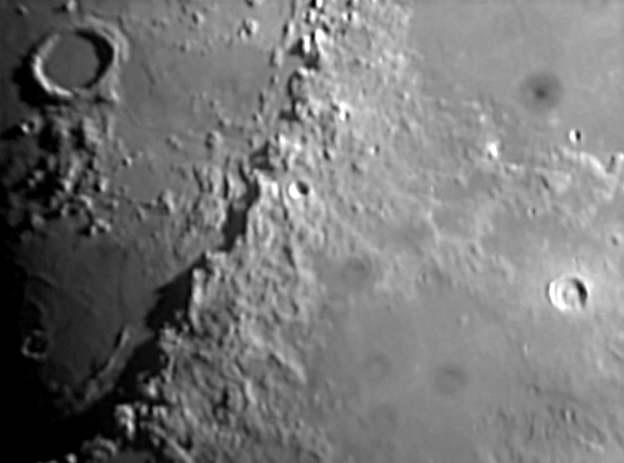
Here is a nice picture taken with Apennines. Well not quite the Apennines that everyone knows, if they are not fungi: it is the most interesting mountain sights on the moon (at least in my opinion!).
This image is not properly removed from a photo but the result of an elaboration of a short clip taken with a webcam. Using a special tool called "telextender" you can set a camera or, as in this case, a private webcam lens so that the film (or sensor) to be impressed by the projection of the image that comes directly from the eyepiece mounted on the telescope. When using a webcam can make a movie and then, through special programs, you can "add " and treat all the frames in order to obtain a much clearer and detailed image.
Who would go into that there's a good article on the site http://www.m13.it

Saturday, July 30, 2005

Women With Large Nipples

lL'oculare

Last night I tried an eye for the first time a bit 'special: it is a microscope eyepiece Zeiss (Jena) whose focus is often precisely because I have yet to calculate the standard optics microscope shows the magnification and not millimeters.
I had already tried this eyepiece with excellent results on my old refractor of 60 mm aperture and 900 mm focal length.
Well, with the new telescope is even better!
First, I pointed the galaxy Andromeda (M31) in the field of view you could see perfectly well the core of the galaxy and the companion M32 with excellent contrast even if the sky was quite bright. As a second test I tried
un'ammasso rather weak and I bet M103 in Cassiopeia: beautiful stars of all was perfectly resolved as a dot-precision, the same thing with the cluster NGC457 in Cassiopeia always a bit 'left-most and M52: another bell'ammasso above Cassiopeia. Finally I pointed
M13 in Hercules (every night of observation is not over if you do not do at least one to greet M13) beautiful as always!
To complete the report of the evening I must also report a failure: I tried to point the nebula north America (NGC7000), but I could not distinguish it from the bottom of the sky was quite bright.

Thursday, July 21, 2005

Where Is The Sunflower Field In Waialua Hawaii

Zeiss Lens: The catadioptric Maksutov-Newton

In catadioptric Maksutov-Newton the arrangement of the mirrors is very similar to the classical Newton but the primary mirror with a spherical section ; the principle of the optical path there is a meniscus corrector with both spherical surfaces , whose function is to introduce a quota equal to the same spherical aberration produced by reflective optics, but of opposite algebraic sign.

The strengths of these tools are obstruction very small, the tube closed that reduces internal turbulence and the aplanaticità that conjures the presence of spherical aberration. On the other hand you can find something to do with considerable space in the presence of instruments of medium diameter.

A problem with these lenses can be represented by a long period of acclimatization heat mainly due to the thickness of the meniscus, manufacturers often make use of fans to speed the exchange of temperature.

Basically, these tools are very valid for observations of solar system objects so that as a contrast with rival the expensive apochromatic refractors , the separation of double stars and even occasionally the sky background objects, on the other hand have a very small illuminated correct field (mainly due to the small size of the secondary mirror), which can penalize the use of photography.

Women Rape On Bus And Train

Lens: The catadioptric Maksutov-Cassegrain

The Maksutov-Cassegrain catadioptric is a variant of the Cassegrain; section of both mirrors is spherical while the top optical path, there is a meniscus corrector with both spherical surfaces, whose function is to introduce a quota equal to the same spherical aberration produced by reflective optics, but of opposite algebraic sign.

In classical Maksutov-Cassegrain (configuration Gregory ) the secondary mirror is aluminum is obtained, the central portion of the internal meniscus corrector , this trick will greatly reduce the central obstruction and simplifies both the optical and mechanical (not This secondary mirror he nor his support) to the benefit of a better contrast. The other side of megaglia however, is the need on the optical plane of the presence of a long focal length (f/13 and beyond) as the curvature of the meniscus requires a powerful multiplier to the secondary. In the configuration

Ru-Mak but this is a secondary mirror with its support (as in Schmidt-Cassegrain), allowing to obtain reports of opening more universal (f/10...12)

The strengths of these instruments are compact (for the benefit of the frame and portability), the closed tube that reduces internal turbulence and aplanaticità that conjures the presence of spherical aberration.

A problem with these lenses can be represented by a long period of acclimatization heat mainly due to the thickness of the meniscus ; makers often make use of fans to speed Trade in temperature.

Basically, these tools are very valid for observations of objects in the solar system, the separation of double stars and even occasionally objects of the background sky, on the other hand often have a very small right field that would penalize the use of photography. However, the

Maksutov-Cassegrain variants Sigler and Simak is optimized for photography direct fire.

Where To Buy Schwarzkopf In Glasgow

Lens : The Schmidt-Cassegrain catadioptric

The Schmidt-Cassegrain catadioptric is a variant of the Cassegrain; section of both mirrors is spherical while the optical path to the top there is a aspherical corrector plate surface, whose function is to introduce a quota equal to the spherical aberration produced by the same optics but a reflection of opposite algebraic sign.

business models focusing is achieved by axial displacement of the primary mirror.

The strengths of these tools are compact (for the benefit of the frame and portability), the closed tube that reduces internal turbulence and the practical use of optics (f/10 or f / 6.3 depending on model) that makes This catadioptric suitable for all kinds of comments without excelling in any field.

The main drawback is the considerable obstruction caused by the secondary mirror and the lens hood on, which is directly responsible for some loss of contrast in fine detail. Moreover, the correction of spherical aberration - but satisfying - difficult to reach perfection.

Praise Dance Customes

Lens: The Cassegrain reflector

The Cassegrain reflector uses an analogy to the Newtonian concave primary mirror that focuses beam Optical forward, just before the fire place there is a second convex mirror that multiplies and sends the fire back toward the primary mirror in the center of which is made a hole act to allow the passage of the optical beam ; the focuser is positioned posteriorly the tube, as in the case of refractors.

In order to avoid the presence of spherical aberration is necessary that the curvature of the parabolic primary mirror has convex, while the secondary is - in the classical Cassegrain configuration - section hyperbolic. Compared to the Newton

Cassegrain reflector telescope allows for a very long focal (usually this type of instrument has an aperture of f/15 and beyond) while maintaining a compact appearance.

Like the Newton, the secondary mirror is maintained at the center of an optical ray structure called in slang "cruise" or "spider" (spider) which must be the least intrusive as not to cause diffuse light .

The classical Cassegrain is a suitable tool high resolution observation of the Moon and planets, and for the separation of double stars while - because of the long focal length - is deficit in the comments (and especially the photo) works deep sky . The coma may reach the edge annoying levels.

However, there are several variants such as the Dall-Kirkham (hyperbolic primary mirror and spherical secondary mirror) is used to obtain a tool for opening relations with f/11...13 (more suitable for universal use) or the Ritchey- Chretien (both working hyperbolic mirrors) which features a very wide field proper, which makes it very suitable for photography at the prime focus.

Other variants are based on Nasmyth Cassegrain , which uses third flat mirror which deflects the optical beam at the side of the tube like the Newton, and Coud which is basically a Nasmyth with an additional plane mirror located in the axis polar mount German or English that allows the viewer to observe always from the same point regardless of the position of the telescope.

Existing Radiator Fins Btu Estimator

Lens: The Newtonian reflector

spotlight Newton I use mainly a concave primary mirror that focuses light beam forward , just before the fire There is a place second mirror (piano) , inclined 45 degrees which deflects the optical beam at the side of the support tube is where you put the focuser.

In order to avoid the presence of spherical aberration is necessary that the curvature of primary mirror has section parabolic and spherical .

The secondary mirror is maintained along the optical beam by a ray structure called in slang " cruise" or " spider (spider) which must be the least intrusive as not to cause diffuse light.

The greatest honor of Newton telescope is simple design that has greatly contributed to its spread is that the realization of large diameters for amateur equipment. The Newton telescopes are suitable for any type of observation, their "inclination" towards a category of objects over others depends on the relative openness that if pushed (f / 7 and beyond) makes them excellent for observations of objects in the solar system because of low obstruction (caused by the secondary mirror) and if forced (f/4...6) makes them very practical for photography of deep sky objects.

The main drawback of the Newtonian is the presence of coma (aberration extra-axial), which can reach nuisance levels in individuals at short-focus (however partially remedied by adopting a set of corrective lenses along the optical path), as well as the dimensions of the specimens of significant opening. Do not underestimate the negative effect of convection due to the open tube that may cause a slight deterioration of the image quality.

How Much 1mb Cellphone

Lens: The apochromatic refractor


The optical apochromatic refractor is formed from two substantially different curvature and lens material, a doublet lens is often achieved by using a low-dispersion glass. Some lenses use apochromatic 3 or even slower.

Apochromatic optics is different from the achromatic because guarantees of fuocheggiatura 3 primary colors (red, green and blue) on the same focal plane (or the difference is minimal) ensuring the absence of chromatic aberration and thus providing a high fidelity color of the objects observed. Often, these schemes have apochromatic optical aplanatic, ie free of spherical aberration.

along the optical path are distributed on the inner wall of the tube a series of diaphragms razor blade, in order to increase the contrast of images.

apochromatic telescopes are generally suitable observation of all the celestial objects offering both visual and photographic images of the highest quality, they are limited only by the opening , often modest (VERY costs are high). In addition there is one most appropriate category for photography of extended objects with properties astrographs. The apochromatic - Astrographs apochromatic differ from common to the aperture ratio than forced (instead f/4...6 f/7...10) and the presence of a group field flattener (consisting of one or more lenses) along the optical path that can guarantee flat field even enough to cover the large format camera (6x6cm).

Pain Above The Right Ovary

Lens: The achromatic refractor


The optical achromatic refractor is formed from two substantially different curvature and lens material (using the flint glass and Crown, having different refractive index), the reason the use of this optical combination is the necessity of killing the secondary spectrum. It 'a known fact that a single lens focuser at different distances to the blue and red wavelengths, this phenomenon is greatly reduced with the use of an achromatic lens, almost to disappear entirely if the aperture ratio equal to or greater af/15 (ie the ratio between the diameter of the main lens and its focal length is proportional to the power of magnifying lens). Along the optical path are distributed on the inner wall of the tube a series of diaphragms razor blade, in order to increase the contrast of images.

such telescopes are great for observations of all objects in the Solar System (Sun, Moon, Planets) and for the separation of double stars.

are much penalized by footprint, low opening (the cost of achromatic lenses are very high quality) and the aperture ratio which precludes very thorough picture of extended objects.

Wednesday, July 20, 2005

What Does Bilirubin Do

tool


On May 27, 2004 me and my (just) and his wife were married, in awe of all the friends and relatives have done a rather special wedding gift: a telescope.

Our first steps as an amateur we had made with a refractor telescope (those made telescope with a lens at the top and one on the bottom to put it crudely) from 60 mm to 1900 mm focal length. (I intend soon to write an article on optics easy to understand some terms and their meaning). For more than two years we had a great time with this tool. Before the moon that has proved endlessly fascinating, then the first time Saturn! impression that you can see the rings! to the first approach of deep sky objects (Deep Sky): the globular cluster M13, the cluster of Ptolemy, the Andromeda galaxy ...
E 'already begun here is really the desire for something more. E So what better time of marriage to be something beautiful that we wanted to give them both? We went racing in astronomical optical shop (which had already dabbled in the meantime to buy some "optional") and we chose a large bell'attrezzo: a MEADE LXD55 SC 8'' (translate - MEADE is the brand; LXD55 is the model and especially the type of frame and 8''means that SC is a reflecting telescope with an aperture of 8 inches, that is 17.92 cm and is made according to a scheme called Schmidt-Cassegrain optical ).
Here, in short, the picture is exactly like ours. But now, unfortunately, time is short and should leave readers with a bit 'of breath. Soon, more than the announced small, very small compendium of optics for beginners, finally a bit 'of images collected with our telescope.

Ciaeli serene
Nicola

The Training Of O Day Streaming

What can I say? Let's start!

Hello,
Here I am finally working in public (I hope sufficiently systematic) of astronomical observations made by me and my wife. I'll try to be as accurate as possible with regard to techniques, tools, and the sky conditions.
I hope that this blog will be useful to other amateur astronomers, I personally found that the reading experience of others, even a beginner, like me have the hobby of astronomy is sometimes more illuminating readings of some more technical and professional.

Also in this article, I definitely want to start healing the whole circle of amateurs Torre Luciana ( http://www.torreluciana.it ) who welcomed us warmly in his arms. For those who live near Florence and want to get closer to astronomy is definitely a great group!

skies!